Getting started with a guitar may be difficult but once you have gained the pace you would enjoy learning to play guitar. It is normal to feel a little daunting, but generally, if you keep these few things in mind, you’ll be off to a great start.
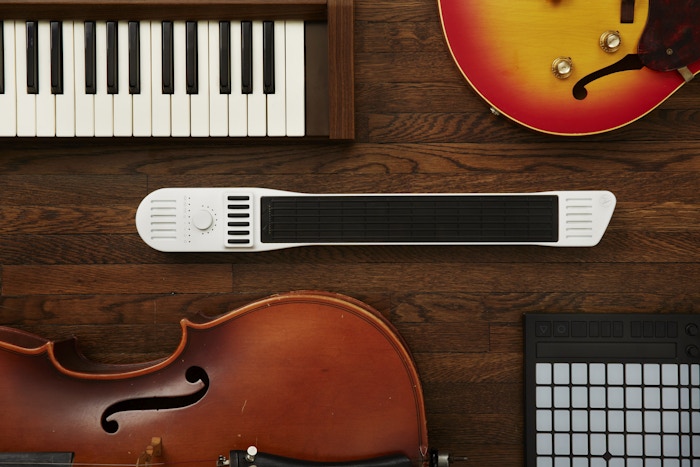
Instrument 1 is a Kickstarter project by Artiphon. Artiphon is a Nashville base start-up by Mike
Butera and Jacob Gordon. Instrument 1 is a multi-instrument, Now whats a multi-instrument? A guitar is designed to be strummed; piano keys are pressed; drum
pads are tapped; violins are bowed. But what if a single instrument
could be played with any of these techniques? That's exactly what a multi-instrument is. According the creators of Instrument 1 their patented technology enables a new type of musical experience
focused on exploration and creativity rather than skill sets and signal
chains. It’s an entirely new approach to what a musical instrument can
do.
What Instrument is capable of?
Can play any instrument, style, and sound with a single device that connects directly to your smartphone, tablet, or computer.
INSTRUMENT 1
can be played as a guitar, violin, bass, piano, drum machine... it's any instrument
you want it to be.
Plug in and play 100’s of apps like GarageBand with universal musical gestures: strumming, tapping, bowing, sliding, and more.
Digital string-like interface works with any MIDI-compatible software.
The unique ergonomic design can be held in multiple positions, and is fully ambidextrous.
Design new instruments and custom tunings via the Artiphon companion app.
It's compact, portable, durable, self-powered, and simple.
How it is Played?
The INSTRUMENT 1 to adapt to the
way you want to play, and it scales in complexity based on your style
and skills.
If you want to play like a guitar, you can chord and strum in
familiar ways. In a piano preset, put it on your lap and the frets
become “keys” like a piano (with up to six stacked octaves at your
fingertips!). If you’re a drummer or a DJ, transform a whole fret into a
pressure-sensing pad like a drum machine. And if you want to play a
violin or pedal steel, slide your fingers along the strings to create
sweeping fretless melodies.
What if you aren't a Musician?
You've got this. Our goal is to create the most effortless
music-making experience at any skill level. Music isn’t about gear; it’s
about self-expression. Every aspect of the INSTRUMENT 1 can be
customized to behave the way you want it to. Tune it all to E-major if
you like, adjust the sensitivity, or forget strumming altogether and let
it auto-play the notes you press.
Effortlessly explore and create together.
The INSTRUMENT 1 grows with you as you explore new styles of playing.
You can increase complexity as you go, allowing for greater control
over every aspect of your performance with its feather-touch playing
surface. It's always in tune, and you'll never break a string!
Interfacing with Smartphones and PCs
Connect the INSTRUMENT 1 can be connected to hundreds of apps on mobile devices and
computers, and it can literally make any sound imaginable. No really,
we’re serious.
For instance, you can plug it into Apple’s
Garageband and start strumming. If you’re set to a guitar sound, it will
sound like a guitar. Then switch to piano, and start matching your
technique to new sounds. Or open a synth app like Moog’s Animoog and
explore sounds you’ve never heard before.
Because the INSTRUMENT 1 is fully MIDI-compatible, it works with
100's of MIDI apps and software like Ableton Live, ProTools, Logic, and
many more on your computer. The Artiphon INSTRUMENT 1 connects directly to iPhones, iPads, Macs, and PCs via Lightning or USB.
It
works with any music creation software that uses the MIDI standard,
which is the universal language of digital music. MIDI has been around
for over 30 years, and lets electronic instruments tell each other what
notes to play and how they should sound. But don’t worry: we’ve made it
easier than ever to get started making digital music; no acronyms
required.
Nashville Edition with hardwood back
Oh, and did we mention it has built-in speakers? This means no more
worrying about external speakers when you play with your favorite apps.
It's loud enough to play and sing along with friends, and you can even
use it as an external speaker when you're not making the music. Of
course, there’s a headphone output if you want to keep it quiet until
you drop the album.
Artiphon App
Artiphon is creating a companion app so you can customize your
INSTRUMENT 1. Basically, you can easily create new instrument presets
and play them immediately. Want to strum a piano? Bow a banjo? Pluck a
drum? Done.
Create and play new instruments in seconds.
It’s a great way to get inspired to play new styles of music. Whether
you’re a songwriter, electronic music producer, or just playing your
first notes, Artiphon lets you try out many different styles and sounds.
Strings that do not break
One of the revolutionary things about the Artiphon INSTRUMENT 1 is
its string-like playability on a purely digital device. Use hammer-ons
and pull-offs on on the fingerboard, strum on the bridge, and the notes
ring out based on the velocity of your touch.
Artiphon’s patented technology also enables entirely new musical
techniques, letting you play in ways that no stringed instrument ever
could:
1) Turn the frets on and off. This is the first digital string-like
instrument to support fretless playability, which is revolutionary for
violinists, bassists, and anyone interested in sliding between notes.
2) Use vibrato to naturally add real nuance to your performance.
3)
The entire interface is continuously pressure-sensitive, allowing for
unprecedented control over software instruments via polyphonic
aftertouch.
4) Instantly change to any tuning (guitar, bass,
banjo, dobro, uke, violin... koto anyone?), with capo buttons at your
fingertips.
5) Assign a different instrument to each string. For example, play a bass on the bottom and a guitar on the top.
6) Pressure-sensitive effect control, tap and auto-strum modes, multiple notes per string...
Features
Back the project on KickStarter
Funding for this project is live on Kickstarter. You can back this project on Kickstarter, click on the link to follow to Kickstarter profle.
According to an investigation of the association between playing a musical instrument and brain development, kids who are trained in music have better attention spans, a better grip on their emotions, and are less likely to be anxious.
Psychologist have studied the connection between musical training and brain development to find that the hobby can shape a young person’s brain and help them with functions such as emotion processing and focusing attention.
Run by researchers at the University Of Vermont, College Of Medicine in the US, the study follows on from research conducted previously by professor of psychiatry and Vermont Centre for Children director, James Hudziak. In previous years, Hudziak had been working with the US National Institutes of Health to complete an MRI study of what normal brain development looks like. His team then used this data to observe the brain development of 232 children aged six to 18. Children have particularly adaptable brains, and as they grow up, the outer layer of the brain - the cortex - experiences changes in thickness. In an earlier study, Hudziak and his team first discovered that thinning or thickening of specific areas of the cortex can be linked to instances of anxiety or depression, problems with attention span, aggression and other behavioral problems, even in kids who are otherwise perfectly healthy. More recently, the team decided to see if a ‘positive activity’ - for example, musical training - could influence cortex thickness and mitigate any negative effects.
Publishing in the Journal
of the American Academy of Child & Adolescent Psychiatry, the team’s
findings support a model proposed by Hudziak called the Vermont Family Based
Approach. Rather sensibly, the model suggested that everything in a young
person’s environment, including their family, friends, teachers, pets, and
hobbies, all contribute to their psychological health. And “music is a critical
component in my model,” says
Hudziak in a press release.
The team found that because learning a musical instrument calls for control
and coordination of very specific movements, the activity alters the motor
areas of the brain. But it also controls the changes experienced by areas of
the brain that regulate behavior. For example, it reportedly influences
thickness in the part of the cortex that relates to "executive
functioning, including working memory, attentional control, as well as
organization and planning for the future,” the
team writes.
They also found that a child's musical background was also correlated to the
thickness of the cortex in areas that play a crucial role in emotion processing
and inhibitory control.
Referring to the fact that three-quarters of high school students in the US
rarely or never take up a hobby in music or the arts, Hudziak says we need to
make an effort to make these activities more attractive to young people.
"Such statistics, when taken in the context of our present
neuro-imaging results," the
team writes, "underscore the vital importance of finding new and
innovative ways to make music training more widely available to youths,
beginning in childhood."